

A defining decade: from Paris to Belém
Ember Current – December 2025 Newsletter

Director of Policy and Strategy
Ember
Ten years ago I was in Paris, along with 40,000+ other delegates, for the seminal UN climate summit. I was speaking live on BBC World News just as the Agreement was formally concluded – and it felt like the historic moment it was, marking the first time that every country had pledged to constrain its greenhouse gas emissions. Yes, on that bright Paris winter morning, the world did feel a little different.
A decade later, we’ve just seen the COP30 finish in the Amazonian city of Belém. And a decade is a good period over which to take stock of progress.
The energy transition has been faster than I or many other Paris Summit delegates would have predicted. In Berlin, where I live, the latest manifestations include solar panels on balconies and EV charging stations on street corners. Around the world, electrotech is deploying at rates unimaginable a decade ago. With solar and batteries posting exponential growth year after year, the rapid progress of the energy transition is a wonderful story to be telling.
Seeing this newsletter for the first time? Scroll to the bottom of this page to subscribe and get Ember Current monthly – directly to your inbox!
Insights, analyses and commentaries
My top picks
There are a few arguments that you see time and time again when it comes to the clean energy transition. One: despite the exponential rise of solar and wind generation, they will never grow fast enough to stop growth in fossil fuel generation. But in the first three quarters of 2025, solar and wind grew fast enough to keep up with demand, stagnating fossil fuel growth. Two: the 2015 Paris Agreement had no impact on the progress of clean energy. Yet solar growth is surging, providing ten times more electricity now than it did ten years ago.
Q3 Global Power Report: No fossil fuel growth expected in 2025
At COP30 we released a global data snapshot showing that in the first three quarters of 2025, fossil fuel generation didn’t grow at all – and there are some indications that this is a structural shift caused mainly by the exponential growth of solar.
The year sunlight went global: How the Paris Agreement brought solar power to the world
The Paris Summit saw governments making national plans for renewables, setting up global initiatives, enacting forward-reaching policies and stimulating solar panel manufacturing. In this report, we looked back at how this all worked, and how it helped the world’s solar power centre move from developed to emerging economies.
There’s more!
- Chasing volume, losing value: The cost of coal over-expansion in Indonesia | Read the report
- Ignore the fossil noise, the electrotech revolution is happening | Read the report
- Shockproof: How electrification can strengthen EU energy security | Read the report
- Reducing curtailment in Chile: Unlocking the full potential of renewable energy | Read the report
- China Energy Transition Review 2025 | Read the report
Ember in the news
- Solar and wind power has grown faster than electricity demand this year | Associated Press
- Smart grids can drive ASEAN’s industry boom | China Daily
- Indonesia’s coal boom hits wall as methane soars, profits sink | Business Times
What I’m reading
Visual storytelling corner
Chart of the month
I chose this chart because it shows how dramatically India’s solar generation has expanded since the Paris Agreement – growing nearly twenty-fold to a scale comparable to the entire electricity demand of countries like Colombia and Norway. The clear upward line makes the pace of change unmistakable.
This graphic reinforces a central message: major emerging economies are now driving the fastest clean power growth. India’s solar surge demonstrates how renewables can scale quickly enough to curb fossil dependence and keep global climate goals within reach, offering a powerful example of coal-to-clean momentum in action.
Turning data into action
Data highlights

Our 2030 Global Renewables Targets tracker got a major overhaul
With COP30 negotiations settled, explore how far the world has already advanced towards the goal of tripling renewable capacity by 2030, and identify which countries are leading the charge.

Global renewable capacity additions are forecast to reach almost 800 GW in 2025, an 11% increase over 2024
This puts the world ahead of the pace needed to triple renewables by 2030. While the growth of annual additions from 2023-2025 exceeds the required rate to reach this goal, national 2030 targets still only add up to a doubling rather than the tripling commitment made at COP28.
Country spotlight
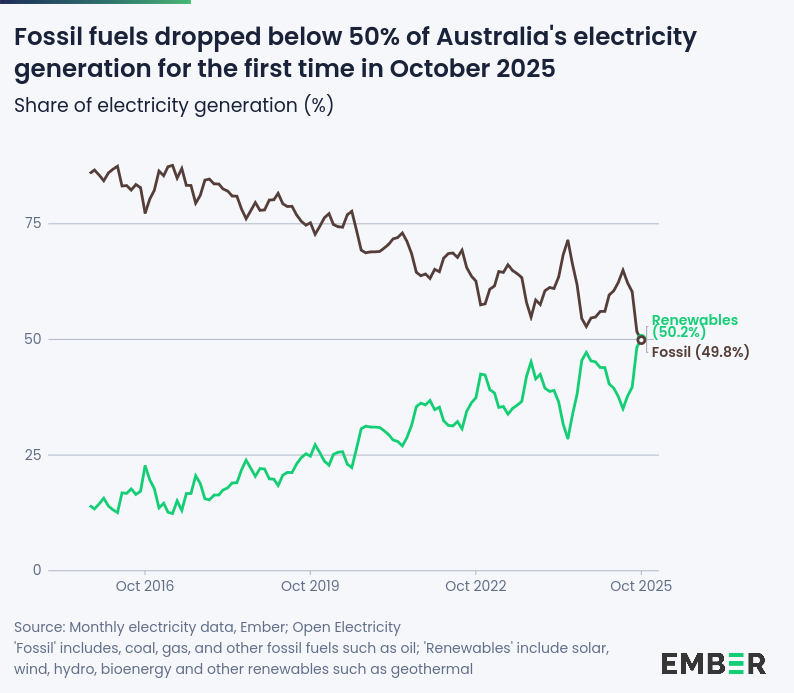
Australia has crossed a historic threshold: In October 2025 it generated more than 50% of its electricity from renewables for the first time, up from just 14% a decade ago. Recently announced as the leader of COP31 negotiations, Australia is showing how policy, investment and technology can rapidly transform power systems – and how global momentum is shifting in favour of a completely carbon-free power system.
Making an impact
Ember at COP30
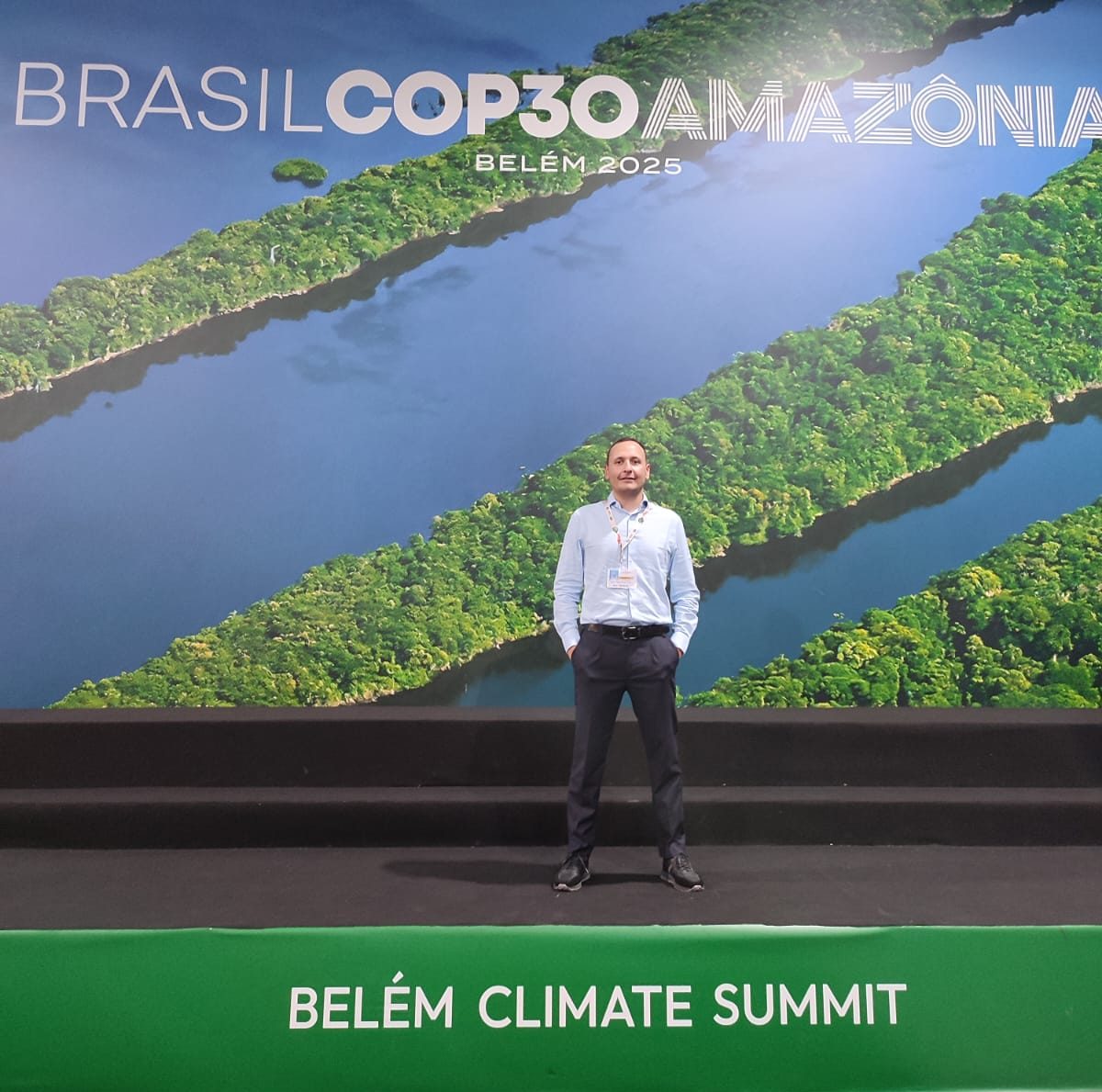
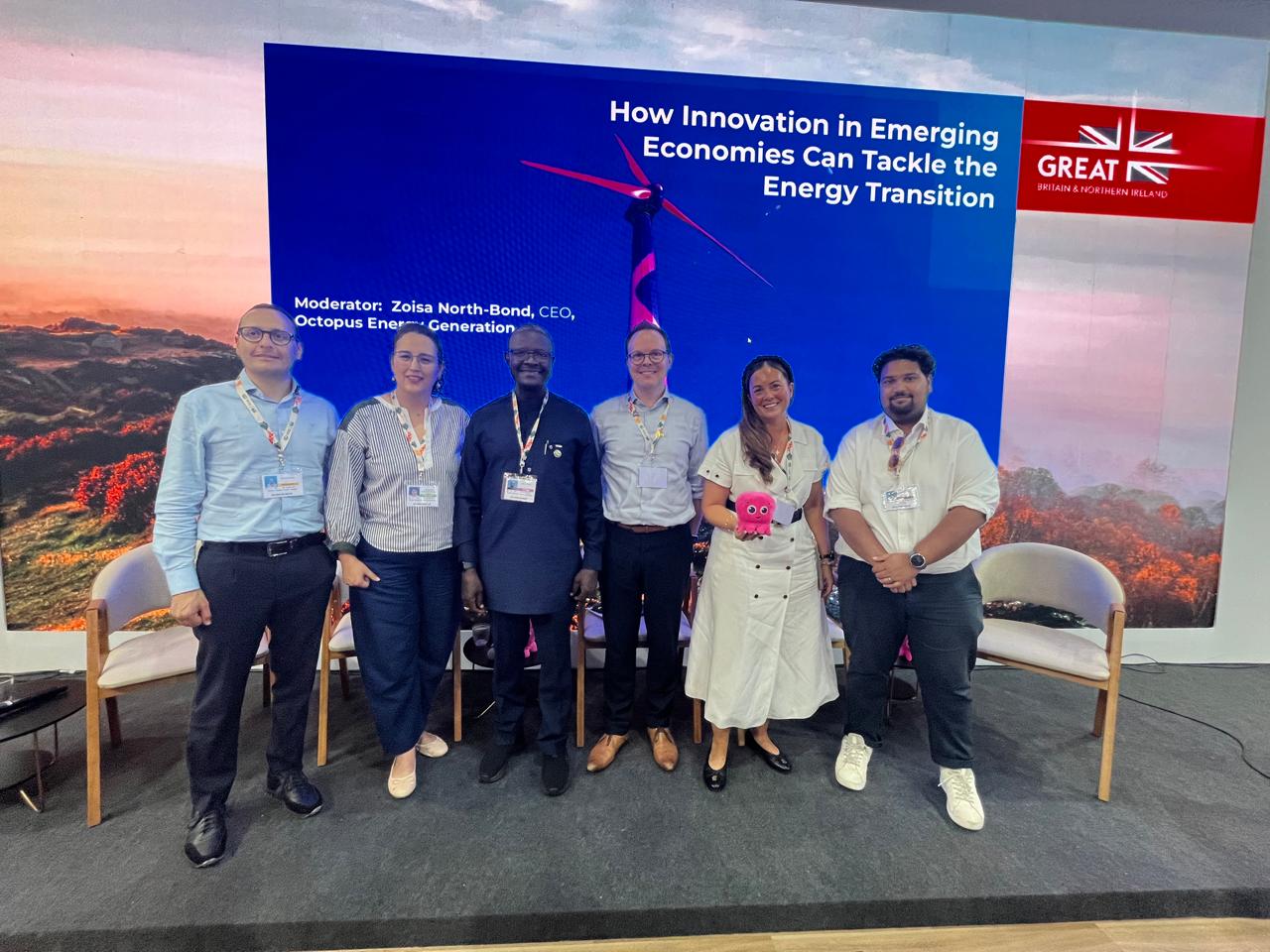
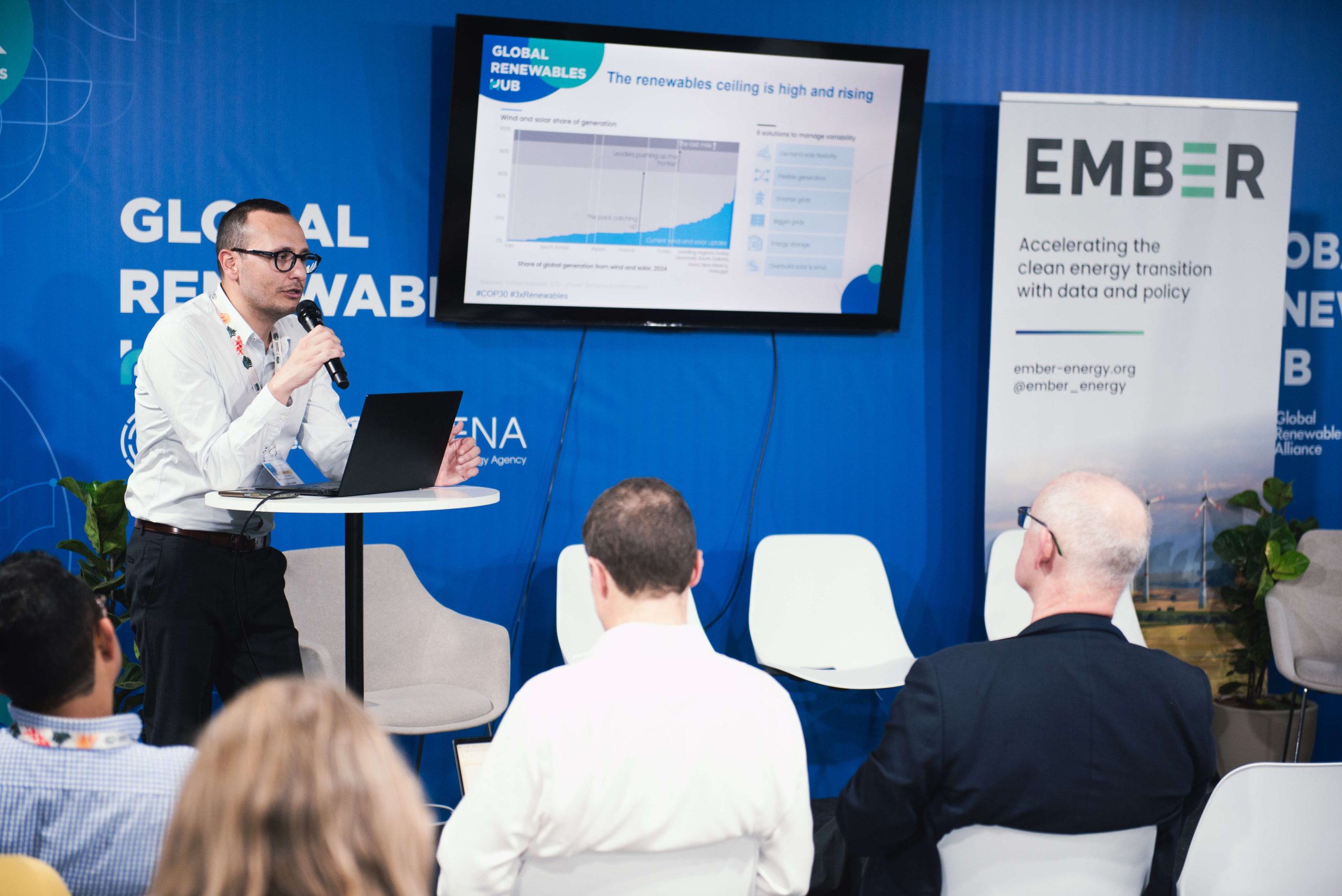
My colleague, Wilmar Suarez, represented Ember at COP30 in Belém this month. We co-hosted an event with Global Renewables Alliance about how the electrotech revolution is changing the global energy landscape and how countries can fully take advantage of the benefits electrotech can provide. Wilmar also participated in events hosted by Octopus Energy, Renewables First and We Don’t Have Time to discuss energy transitions in emerging economies. It was a busy summit, with lots of connections to make and work to do!
Ember Current is a revamp of an existing monthly newsletter delivered to our subscribers. Ember Current is written by a different one of our analysts each month, bringing you their own top picks of Ember’s insights and a little window into what has felt important to them over the course of the last few weeks. If you want to receive these updates each month, scroll to the bottom of this page and sign up! For queries and feedback, please reach out to [email protected].
Featured image credits
Cover photo: anatoliy_gleb / Getty images
Acknowledgements
Eli Terry, Claire Kaelin, Burcu Unal, Chelsea Bruce-Lockhart, Jivan Zhen Thiru, Leo Heberer